Monday, September 25, 2023

Fence Post Error


The computer science term “fence post error” refers to a conceptual mistake that puts you off by one. It’s named after a common fencing miscalculation. Let’s say you’re building a 30-yard fence and you need one post for every yard of fence. How many posts do you need? At first blush, the answer seems like it should be 30 posts. However, unless the fence circles back on itself, you actually need 31. The conceptual error that Zinn, Abrams, and I had made was a fence post error. We were off by one!


Beneath the ninth row from the top

Of the wall including small bricks


I found this very confusing. The word beneath is used here to determine a row for counting, not the location of the casque! Of course the casque is going to be beneath the ninth row, somewhere. Everything in the garden is beneath the ninth row of the wall! It is the horizontal counting, to ten, that is meant to indicate the location of the casque. Therefore, in order to count horizontally we must first count vertically, counting down from the top to identify the proper row and then right to left to find the casque. I know it seems like a knit picky detail, one that we shouldn’t have to notice, but I think that’s the point. That’s what makes it so difficult. 

“Beneath” the ninth row is the tenth, so that’s the row we want to use when counting horizontally, not the ninth!  As I counted downward, again and again, I realized that I arrived at a different row when counting from the front (east) side versus the back (west) side of the wall. From the front side, I arrived at the row that Zinn and Abrams had used for counting horizontally. But the tenth row on the back side was underground! What I’d missed was that the front side has a ledge consisting of “small bricks,” a ledge that doesn’t exist on the backside! The only way to count ten rows of stones vertically is to do so from the front!

The phrase “including small bricks” was a hint. I, like Zinn and Abrams, assumed that it referred to the small bricks on the top row only. It also refers to the small bricks that form the ledge in the front.


Welcome to Level 3.

Sunday, September 24, 2023

How Much Does a Hemingway?


One of the most valuable books I ever read was The New Oxford Guide to Writing by Thomas S. Kane. It’s a fantastic book. It gave me a completely different perspective on literature in general. Among other things, Kane breaks down the writing techniques for which certain famous authors are well known: Abraham Lincoln being the master of embellishment; Twain, exaggeration; and Hemingway, the mistake. For me, this last technique made reading and writing far less intimidating and far more interesting. 

The idea that you could bend or break the rules of writing to convey information was liberating. It felt a bit like Neo bending or breaking the rules of the Matrix. Hemingway, for example, used run-on sentences to indicate that the narrator was in a dreamy or whimsical state of mind. Here’s an example from A Farewell to Arms:


That night at the hotel, in our room with the long empty hall outside and our shoes outside the door, a thick carpet on the floor of the room, outside the windows the rain falling and in the room light and pleasant and cheerful, then the light out and it exciting with smooth sheets and the bed comfortable, feeling that we had come home, feeling no longer alone, waking in the night to find the other one there, and not gone away; all other things were unreal. 


Byron does precisely this, breaking the rules of puzzle writing to convey information. The mistake Byron used as a hint was to list the instructions out of order. For example, “Seek the columns” should come first, but it’s near the end. “In a rectangular plot,” should come near the end, but instead, it appears near the beginning. Byron is telling us, through these ordinal mistakes, that executing the steps of the puzzle in the right order is part of the challenge. This questioning the order of the instructions combined with questioning the original assumptions was what led me to figure this out (in my opinion, of course).

Saturday, September 23, 2023

Proving Jesus


Religious dogma, due to its spiritual nature, can not be proven. However, I once had an evangelical preacher tell me (and a group of Christian friends) that he could definitively prove that Jesus was the one true savior. Whenever you hear a fantastical claim like this, there’s almost always the same flaw in the logic. Don’t worry, I’m not going to prove or disprove the divinity of Jesus here, and neither is the evangelical preacher. 

Full disclosure, I do not believe in anything supernatural, which, I suppose, makes me a nonreligious person. I’ve read the entire New Testament and much of the Old, and consider myself to have Christian values, the ones found in the New Testament, such as, “judge not others,” “love your neighbor as yourself,” “love your enemies, pray for your persecutors,” etc. 

The preacher’s logic went something like this: Jesus said, “I am the way and the truth and the life. No one comes to the Father except through me” (John 14:6). The only way Jesus could say this, the preacher reasoned, is if Jesus were a liar, insane, or the one true savior. He then asked if we thought Jesus was a liar or insane. No one wanted to go down that path! No one. We all liked the teachings of Jesus and didn’t want to give the impression that we didn’t. Hearing no argument to the contrary, the preacher concluded that Jesus was the one true savior, the only other possible explanation. 

Do you see the flaw in his logic? You could, of course, argue that Jesus fits into one or both of the first two categories, or that there’s a fourth category, but that won’t be necessary. The problem is with the original assumption, that these are the exact words of Jesus. We don’t know that. In fact, there’s a lot of evidence to the contrary. Most scholars believe that the book of John was written somewhere between 500 and 600 years after the death of Jesus. In the book The Five Gospels by Robert W. Funk and Roy W. Hoover, the authors present all of the quotes attributed to Jesus and rate their authenticity based on analyses by leading biblical scholars. This particular quote rates quite low in authenticity, being that it is inconsistent with the teachings and tone of Jesus. He tended to be more humble, making his teachings about how to live a good life rather than being all about himself. Jesus could, therefore, in theory, be sane, truthful, and not the one true savior. The flaw in the logic was all the way at the beginning, with the initial assumption. 

Having found no solid clues suggesting that the dig instructions were backwards, I started to doubt the original assumptions made by Zinn, Abrams, and myself. Approaching the problem like a bug in a computer program, I went back to the beginning and verified all assumptions. In order to count right to left, I first had to figure out the correct row. A handful of rows could be used for this purpose. I counted down from the top in the middle of the wall, as this is the only place where you can count enough rows—nine rows, right?

Friday, September 22, 2023

Brainstorming


One method that I commonly use is Brainstorming, also known as the Shotgun Approach, where we just try every idea that comes to mind. Here are some of my crazy ideas: 

My first thought was that maybe there was something in a newspaper reference, one by a columnist—“seek the columns.” After searching for a while, I realized that this would have to be multiple articles (columns) because the plural is used, which makes no sense in context. So I tossed the idea. Fail. 

Next I focused on the columns in a table or page of text (i.e., columns versus rows). It occurred to me that the numbers 1442 and 1881 might refer to columns in the poem, revealing a secret message. There are eight digits in the two numbers and eight letters in the word backward. Because so many digits in 1442 and 1881 are repeated, I assumed they must refer to a column offset rather than an actual column. I started with the first line of the poem.


Beneath two countries


The first offset, 1, gives us the letter B. The next, offset from that location, 4, gives us the letter A. The next offset, another 4, gives us (skipping blanks) the letter W. And the fourth offset gives us the letter C. These are four letters from the word backward, out of order, of course. But maybe this is why the lines in the poem are out of order, to hint at an anagram in the columns of the poem. Maybe. I went to the next line in the poem and applied the next number, 1881. 


As the road curves


The next offsets give us a second A and a D, both letters we’re looking for. At this point we’re only missing a K and an R from the word backward. What are the odds of that?! However, at this point we’ve run out of letters in our current line, and the next line doesn’t help. 


In a rectangular plot


In the next line, the next numbers, 8 and 1, would give us the letters A and N, which are not what we’re looking for. The problem is, there are only two K’s in the whole poem and there’s no reasonable way to get there. Grudgingly, I tossed this idea too. It would have been so cool. Fail. 

Next, I looked for a literary reference as Byron has done in other puzzles (see the Charleston, Roanoke Island, and Houston analyses at thesecret.pbworks.com), one involving columns. I searched for classic novels that include both references to “columns” and “backward.” I was thrilled to find a singular reference to each word in neighboring paragraphs in the book Treasure Island (a book alluded to in the Charleston puzzle). Unfortunately, there was no way a person could possibly associate the two words from the text without knowing what to look for. In other words, you couldn’t make the association unless you were specifically looking for it. It’s just a coincidence. Fail. 

This journey down rabbit hole after rabbit hole represents a good chunk of how I spend my time analyzing these puzzles. The tricky bit is knowing when to quit. In this case, we again have to change tactics. 

Thursday, September 21, 2023

What We Know and Don't Know


What We Know

Tying Cleveland to Image 4 and Poem 4 was well established by Zinn and Abrams. Besides the aforementioned details, the month associated with the Cleveland puzzle is March, as evident in the triangle on the sphere (three sides). The flower is daffodil and the gem, aquamarine. These and the details in the following paragraph were discovered by previous researchers and are well documented at secret.pbworks.com.

The latitudes and longitudes that form a box around Cleveland can be found hidden in the clearly displayed numbers 1442 and 1881, almost. By that I mean, if the numbers were 1442 and 1882, then by reversing the first two digits, we would have 41 and 42 latitude, 81 and 82 longitude, which would form a nice box around our city. But those aren’t quite the numbers. The question is, why not? The dig instructions are reversed horizontally, so the number 1882 would still hint at this while also indicating the correct box around Cleveland. I don’t get it. There must be some other meaning to the number 1881, something important. 


Welcome to Level 2. 

What We Don’t Know

  • Backwards: The most important outstanding mystery of all is, why do the dig instructions clearly indicate right to left, when they should indicate left to right? Anyone interpreting the instructions would certainly be standing in front of the planter when counting off the stones. There’s no clear indication that the final dig instructions are backwards.

  • 1442 and 1881: What is the meaning of these numbers? The two numbers, besides hiding latitude and longitude, are presented in a way that would suggest dates. But these dates don’t seem to hold any significance. 

  • Keystone: Why is the gem embedded in the keystone of the arch? This would suggest Pennsylvania, the keystone state—but the casque was found in Cleveland, Ohio. 

  • L and Bell: What is the meaning of the L and Bell near the bottom of the Image? The logical interpretation, combining L and a bell would be the Liberty Bell, particularly since the bell looks a lot like the Liberty Bell. But what does the Liberty Bell have to do with Cleveland? It visited Cleveland on April 27, 1893 on its way to a Fair in Chicago, but the bell visited a number of cities around that time. 

  • The WWI Helmet: Why is the centaur wearing what appears to be a World War I helmet? It seems out of place on an ancient mythological creature. 

  • Free Speech, Couplet, Birch: Each item relates to the corresponding Ancient Greek name in the line above. Socrates chose to die rather than relinquish his freedom of speech. Pindar was a great poet while couplet is a type of rhyme scheme. And Apelles was a great painter relating to paint brushes often being made of birch. What is this line’s purpose in the puzzle? Hmmm. 


Let’s begin our analysis with the final words of the poem as we try to answer our first question regarding the dig instructions being backwards. 


To find casque’s destination

Seek the columns

For the search.


The word seek can mean to look for, attempt to acquire, or go to. The last definition fits with how Abrams interpreted the puzzle. The clues are intended to be interpreted from the perspective of the columns. Consequently, we’re left with the question, is there any other indication that the dig instructions are from the perspective of the east side of the wall while the planter containing the casque is on the west side? The natural place to stand while interpreting the dig instructions is in front of the planter (behind the wall), making the instructions backwards. Is there a more elegant solution that doesn’t involve first digging in the wrong place as Zinn and Abrams did? It feels like there should be. Expecting treasure hunters to randomly try reverse instructions would be tedious, not fun or interesting at all. 

Someone with better eyes than me found the word BACKWARDS well hidden in the cracks of the structure in Image 4. See thesecret.pbworks.com for details. This clue seems awfully thin for such an important detail. Finding nothing obvious telling us that the instructions are backwards, let's skip to our second question and change tactics.


Wednesday, September 20, 2023

Cleveland


Forge thy tongue on an anvil of truth and what flies up, though it be but a spark, will have light.

—Pindar


To be completely honest, I put this particular puzzle off till last. I had no interest in rehashing someone else’s excellent work. This is, in my candid opinion, the only puzzle to date that has actually been “solved” (less the secret of The Secret part, of course). I saw it as uninteresting and offering little in terms of challenges. I was completely wrong on both counts. 

In May 2004, the Cleveland casque was discovered by Brian Zinn and Andy Abrams. The following account is taken from an interview with both Zinn and Abrams in the February 3, 2018 Cleveland episode of The Secret Podcast.

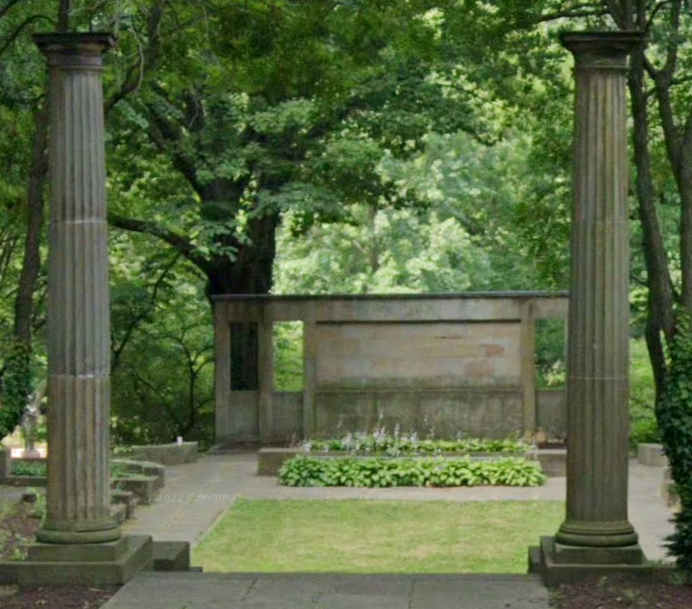
Zinn had studied the puzzles for many years, on and off. Originally, he thought Image 4 related to Philadelphia because of the L and bell next to each other and the gem being mounted in the keystone of the arch. The Liberty Bell resides in Philadelphia and Pennsylvania is known as the Keystone State (because it connects the Northeast with the rest of the country). Everything changed when a gentleman named Johann did an internet search for the three Greek names in Poem 4–Socrates, Pindar, and Apelles, which he learned were carved into a decorative wall in the Cleveland Greek Cultural Garden in Rockefeller Park. He also noticed in Image 4, in the space between the branches, the upside down outline of Cleveland’s Terminal Tower. He soon posted the information on the website quest4treasure.co.uk. Zinn saw the post and immediately noticed that the wall from the Greek Cultural Gardens was hidden in Image 4. 

Everything fell into place after that. Poem 4 was associated with Image 4 by virtue of the reference to the columns. See thesecret.pbworks.com for a great presentation of this and other image matches. This would be a good time to turn to Image 4 from The Secret: A Treasure Hunt. 


Here are the columns and wall.


Zinn got permission from the Cleveland Park authority and set up a time to meet them on site. The day they scheduled their meeting turned out to be the day before Mothers Day, which meant they would only have a few hours to find the casque. Once there, they were able to recognize a number of items hidden in Image 4. They then began to decipher the clues. 


Beneath two countries

As the road curves 


Parkgate Avenue curves around the Greek and Italian Cultural gardens, and the wall containing the Ancient Greek names are downhill from Italian and Greek signs and flags. Surprisingly, the ancient Greek names appear near the end of the poem. The clues seemed to be out of order. The columns are what you pass when you first enter the garden from the main entrance, yet the reference to the columns is at the end of the poem.

Some workers started to set up for a wedding on the large lawn area in front of the wall, so Zinn and Abrams moved to the rear of the wall as they searched for clues.


Seven steps up you can hop

From the bottom level


Behind the wall were five steps leading up to a ledge in front of a rectangular planter. They reasoned that you could “hop up” to the planter, the seventh step. 


In a rectangular plot


This line, they surmised, referred to the planter. They took this to be the approximate location of the casque. They then started to decipher the exact location.


Beneath the tenth stone

From right to left

Beneath the ninth row from the top

Of the wall including small bricks


They carefully counted nine stones down including the top-most layer, which was rather small, and ten stones in that row from right to left. This put them near the left (north) end of the planter where Zinn proceeded to dig, and dig, and dig, for hours. They found nothing. 

At this point, Zinn had done all of the digging and was exhausted. He took a short break to rest. Abrams reviewed the situation and made a brilliant observation. If you stood with your back to the wall or viewed the wall from the other side (from the perspective of the columns), the treasure would be near the right (south) end of the planter as opposed to the left. He prodded the ground in that vicinity, and on his third try hit something that made a scratching sound. With a little digging, he pulled out a large chunk of plexiglass. The box had collapsed over the years, but the casque was still there, intact.

You may ask, Why rehash such an excellent puzzle solution? I asked that same question. But grudgingly, for the sake of thoroughness, I began to analyze this puzzle while writing this book. Having done so for a few weeks now, there are still several outstanding questions that, frankly, I can’t answer. This is an opportunity to give you a window into the circuitous and failure-ridden process I go through when analyzing one of these puzzles.


Welcome to Level 1.


Tuesday, September 19, 2023

The Right Stuff

They say genius is an infinite capacity for taking pains…it’s a very bad definition, but it does apply to detective work.

—Byron Preiss, Son of Sherlock Holmes 


This chapter is about the traits and skills that I believe are important in deciphering these puzzles. First and foremost, I am certainly no genius. However, as the above quote suggests, detective work is less about raw abilities and more about taking pains in just the right way. 


Absence of Ego: There’s an important trait, in my opinion, that is uncommon among treasure hunters, while at the same time common among all those who have found success in this hunt. I’ve observed this quality in the group of young men who found the first casque in Chicago, the two lawyers who found the second casque in Cleveland, and the game designer who identified the general location of the third casque in Boston. All of these individuals share a singular trait that was key to their success—humility. 

Why does humility matter? These puzzles will make a fool of anyone who attempts them, anyone. I don’t care who you are, or think you are. They will wreck you, break you in two. If you’re not okay with that, you’ll never be able to accept and ultimately correct your errors. These puzzles certainly have made, and will continue to make, a fool of me. 

Furthermore, humility opens us up to the ideas and opinions of others. If we are married to our ideas, and our ideas only, we limit our knowledge base. It’s akin to trying to be an expert in all of a huge field of study such as medicine or computer science. It’s important to note that all of the three casques acquired thus far were found with outside help. The young men in Chicago dug at least half a dozen large holes before asking Byron for help. He ultimately sent them a photograph of the exact burial site, after which they still had trouble finding it. The general location of the Cleveland casque was actually identified first by a gentleman named Johann who posted the information online. And the Boston casque was dug up by an excavator during a renovation. All of these treasure hunters benefited from the actions of others. 

Generally speaking, those who are humble won’t tell you about it. Weird, huh? I, for one, am very proud of my humility, and I want everyone to know it. Let’s be clear, I’m quite possibly the most humble person who has ever lived, and, yes, I’m damn proud of it! In all seriousness, solving these puzzles is not about always being right. It's about being able to admit that you’re wrong, and correcting your mistakes, over, and over, and over again.


Bad Dad Humor: Another particularly helpful trait in solving these puzzles is a sense of humor. Most humor, I believe, is the breaking of an expectation, often with a pun. Here are some of my favorite egg samples of yokes: 


What do you get if you cross a white-tailed deer with a blind cave fish? No-eyed deer!


Employer: “Tell me about yourself.”

Applicant: “Well, I just went to Yale for four years.”

Employer: “Yale? Wow! You’re hired!”

Applicant: “That’s great ‘cause I could really use the yob.”


The main difference between dogs and cats can be summed up as the following: A dog, observing that you love, feed, and take care of it, concludes that you must be a god!  A cat, on the other hand, noticing that you love, feed, and take care of it concludes that it must be a god!


Knock, knock! 

Who’s there? 

Mansplaining. 

Mansplain—

It’s when you explain something in an obnoxious and condescending way. Got it?


A comedian, or wanna-be comedian like me, is always looking for puns and the breaking of expectations, constantly exercising the mental muscles needed to solve these puzzles. This punny humor tends to become less common among the extremely intelligent. Most of the really smart people I know tend to opt for dry, satirical, or ironic humor rather than the silly pun-based form. 


A Dreamer: Having the right temperament for these puzzles is also important. There is a simple, yet telling, psychological test that slots people into three general categories. The subject walks into a room, is given a balled-up piece of paper, and told to try to make it into the trash can on the far side of the room. Some people stroll across the room and just drop the paper into the can, done. These are the manager types, people who like to be in control and get things done. Others will approach the can until they feel confident and then toss the wad in. If they miss, as with the first group, they just drop it in, done. Most people fall into this second category, a group that approaches challenges in a sensible and measured way. Finally, a small group of people will toss the crumpled paper the length of the room, retrieve it when they miss, return to the far side of the room, and then keep throwing the full distance until they finally make it, thrilled at their success. These are the dreamers. I think having this tireless desire to succeed at a “long-shot” is an essential part of complex puzzle solving. 


A Knack for Reasoning: Some juggle, some have perfect pitch, some have photographic memories, and some just figure things out. It doesn’t have to come with any other aptitudes we generally associate with intelligence, but a knack for deduction is key to solving these puzzles. Deduction is the one talent that I’ve leaned on throughout my life. My seventh grade English teacher, at the end of the first quarter, gave everyone in the class exceedingly low grades to, in his words, “get everyone in line.“ He approached me after giving out the grades, trying to figure out how I could possibly have done so poorly and well at the same time. He couldn’t get his mind around my getting D’s in reading and spelling (my only D’s ever, by the way), and an A- (probably the best grade in the class) in grammar. It just made no sense to him. It’s important to remember that there are many ways to be intelligent—musically, socially, mathematically, artistically, scientifically, linguistically, athletically, etc. My smarter older brother could best me in any intellectual contest, save one—chess. He too had a hard time getting his mind around that, but there it was. I believe that we all possess a super power of one kind or another. It may be as simple as being able to light up a room with your smile or as complex as being able to write a symphony in your mind. I believe we all have something to offer, something important. 


Attention to Detail: Have you ever visited someone’s home where there was a painting on the wall that wasn’t quite straight, and it took all of your self-control to not fix it? I feel your pain. An obsession with symmetry, order, balance, and correctness is an important trait for anyone trying to solve these puzzles. For example, I skipped the optional final comma before the “and” in the previous sentence, which is inconsistent with the rest of this book, making it a subtle error—and it really bothers me! If, by chance, the comma is there, that means I couldn’t take it and at some point went back and fixed it. 

When I hear someone say, “You don’t know nothin’,” I cringe thinking about what this double negative actually means. When I hear a conditional prepositional phrase like “If I was a rich man…” failing to properly use the subjunctive mood, I die a little inside! Mixed metaphors don’t pass mustard [sic] with me—but malapropisms, on the other hand, I just find supercilious  [sic] !

So many clues in these puzzles are incredulously subtle, itty-bitsy, tiny-weeny inconsistencies that a topical person would just scan over. We must be able to identify, catalog and interpret these numerous imperfections irregardless of our national tendencies. Can you find all 9 errors (or questionable uses of the English language) in this paragraph?


Irrational Curiosity: When my wife and I first started dating and she visited my house for the first time, she came across an issue of Astronomy magazine and brought it to my attention. As I drew in a breath to apologize for my weird interests, as I had many times in the past, she simply said, “That’s really cool.” I knew then that she was the right kind of person for me. We both possess unreasonably curious minds. 

Most people have a practical curiosity regarding those things that affect their daily lives—news, sports, leisure, business, politics, fashion, local events, etc.—the types of things commonly found in a daily newspaper. Then there are those individuals who are passionate about topics that are completely impractical, have absolutely nothing to do with our personal human existence, topics like astronomy, cosmology, evolution, prehistory, etc. I believe possessing an unreasonably curious mind is required to peel back the deepest layers of these puzzles. 

The most challenging mystery is the one we don’t even know exists, the one that’s not on the menu. Many challenges in these puzzles fall into this category, riddles that are only hinted at, secret messages and stories that have no business being there, no business being part of one of these puzzles at all. Some challenges only exist as a pattern found among many clues. The secret of The Secret for each puzzle described in this book is like this. Each is an answer to a question that was never asked. Only a person with a deep-seated irrational curiosity would ever bother to answer all of the ridiculous questions necessary to solve these puzzles. 


Love of the Pure Mystery: Finally, in my opinion, the most important trait in solving these puzzles is having an affinity for the Sherlock Holmes stories, not the slipshod copy-cat versions, but the originals authored by Sir Connan Doyle himself. I read them as a kid, and they had a profound impact on me. I was taken with the idea that with the proper frame of mind, process, and technique, I could solve almost anything. Having a smarter older brother, like Sherlock, may have also contributed to my enthusiasm. I find it fascinating that the whole field of forensics can trace its origins back to these very popular stories, that fiction could have such a profound impact on the real world. 

Riddles 101

  The key to most riddles is perspective, ascertaining who or what the riddle is about. Let’s take an example: What has three arms, wears a ...